
#Digitaltool Using QR Codes: Within Everyone's Reach

With the widespread adoption of smartphones, the impression may have developed that QR codes simply hide websites that you can open with your smartphone camera without tedious typing. Yes, that's true! But those who understand how to use QR codes for their own purposes gain an efficient, cost-effective, and easy-to-use tool for conveying detailed information.
The best part: you don't have to be an IT professional yourself – anyone can easily generate their first QR codes free of charge…
How It All Began
QR codes have been used in industry for over 20 years (developed in 1994 by DENSO WAVE INCORPORATED, Japan). As an evolution of the barcodes in use since the 1940s, they are now used in a wide variety of ways. QR stands for Quick Response and refers to the fast readability of the encoded data. As a two-dimensional evolution, QR codes can contain far more data than one-dimensional barcodes. A major advantage lies above all in their size. Barcodes quickly become very large as their content increases, whereas a QR code occupies a constant area. Micro QR codes, an even smaller variant, often also fit on small components where there is no longer any room for barcodes.
Numerous Use Cases and Areas of Application
In addition to the websites mentioned at the beginning, other standardized data can also be stored. For example:
- Phone numbers
- Business cards
- Geo-coordinates
- Appointments
- **Wifi hotspots **
These are recognized by most smartphones and forwarded to the right apps. Even more interesting, however, are the use cases that give your company a boost, whether in manufacturing, logistics, customer retention, assembly, on-site maintenance, traceability, and much more.
Successful Real-World Examples
1. More Time- and Cost-Efficient On-Site Maintenance and Repair
A machine manufacturer equips its service technicians with tablets. When a customer reports a service case, the service technician on site can use their tablet to scan the QR code on the affected machine. The tablet connects to the customer database and can retrieve all of the customer's machine data, e.g. warranty coverage, last maintenance, and installation data. In addition to customer data, machine-related data such as installation manuals, parts lists, and maintenance schedules can also be made available.
If even components and spare parts in the service vehicle are labeled with QR codes, it is easy to record which parts were replaced during a repair. This makes it possible to track, error-free and audit-proof, which parts were installed in which machines. This can even go so far that when a spare part is installed, the warehouse is notified and the missing spare parts are already restocked for the service technician by the next morning, while they are still away.
If needed, QR codes can also be created cost-effectively on the go using mobile label printers. Many manual steps, rework, and errors can thus be avoided in a simple way.
2. Easy Networking and Instant Completion
Do you have the LinkedIn app installed? Tap the small QR code icon in the search bar and you will find the QR code for your profile.

You can also switch to the scanner there to scan another person's QR code on LinkedIn and open their profile. From there, only the next step of connecting remains. In this way, connections can already be made quickly in many other apps today. Whether it's team members joining teams quickly and easily, or payments in payment apps that are made quickly and without complications. Anything that can be done immediately, quickly, and without complications is far more likely to happen than tasks that you have to do later, as follow-up work, in a complicated way.
3. Digital Validation and Logging of Individual Data, e.g. at Events
Probably the best-known scenario of our time is the digital vaccination certificate. A person's vaccination status is conveniently presented (also encrypted) in the form of a QR code. A smartphone app for validation reads the content via the built-in camera and checks its validity. Personal data can remain protected in the process. With logging, as in the Luca app for example, user data is stored centrally so that it can be evaluated or further processed at a later point in time.
Digital tickets follow a similar approach. The printed QR code is checked at the entrance quickly, contactlessly, fault-tolerantly, and in a user-friendly way. In combination with turnstiles,** large crowds of people can be processed** very quickly. In addition, the issuer can say precisely at any time who entered a venue, when, and where. It also ensures that a ticket is not used a second time.
Technical Advantages, a Win
- More flexible and rich content (text, numbers, symbols, binary data) in a comparatively small representation.
- Small footprint: Thanks to the two-dimensional representation, only about 1/10 of the physical size of a barcode.
- 360-degree readability: The three squares in the corners allow quick detection of the orientation.
- Thanks to effective error correction, data can often be reliably reconstructed despite dirt or damage.
- Simple and cost-effective generation using freely available software libraries or generators on the internet (e.g. QR Code Monkey)
- SQRC and FrameQR offer diverse and aesthetic design options
- High availability of readers (widespread adoption of smartphones)
Examples
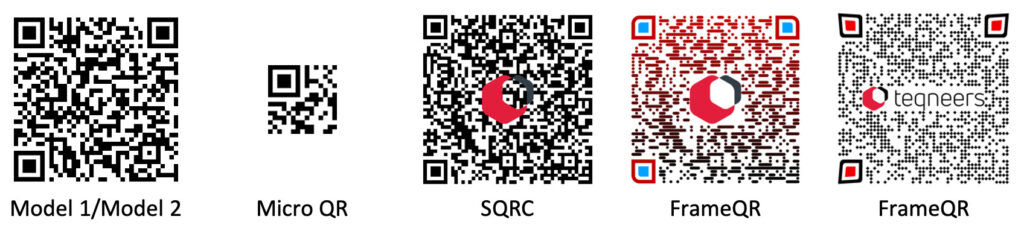
Caution! Risks and Limitations
Despite the versatility and advantages of QR codes, they are not always the best choice. One of the biggest risks for users is that you cannot tell in advance what is hidden behind a QR code. If you scan QR codes from dubious sources with your smartphone and open the content unchecked, you may quickly pick up malicious code.
Due to their square shape, QR codes cannot be used everywhere – for example, barcodes are easier to place on cables due to their elongated and round shape.
QR codes cannot always be captured by scanners on uneven surfaces. For this case, there is also a rectangular variant (LQR), but this too requires a scannable two-dimensional surface and cannot be used on thin cables.
What Should It Cost
Using QR codes usually turns out to be much cheaper than expected. If you only want to store standardized formats, you can start free of charge today and generate your own QR codes using generators on the internet.
- Free of charge are, for example, individual online-generated QR codes for your own business card, a link to the digital menu in a restaurant, links to further articles or on posters and T-shirts, guest access for your own WiFi network;
- **a few hundred euros **is what it costs if the individual QR codes are to be produced in series;
- starting from a mid four-figure amount, custom apps (see real-world examples) are developed that automate individual workflows.
Conclusion
In short, QR codes offer a very simple and very efficient way to transport data from A to B. This avoids errors in transmission, and QR codes play an essential role in the tracking, identification, and validation of data. Thanks to the widespread adoption of smartphones and cost-effective generation, competitive advantages can be achieved quickly, costs reduced, and customer loyalty strengthened.